


Supported by Zubaan
In collaboration with Royal Enfield
APPLICATION DEADLINE: 4 JANUARY, 2026
Background
Over the past decade, Zubaan has been working closely with young artists, researchers, writers, and community storytellers across Northeast India and the Eastern Himalayas, building platforms to support feminist and community-rooted knowledge production. Through long-running initiatives like Cultures of Peace and Fragrance of Peace, we’ve nurtured conversations around gender, identity, conflict, ecology, and justice — often outside the margins of mainstream discourse.
Our young researchers grants have played a key role in this journey, offering space and support to those telling stories from places that are often unheard — stories of land, resistance, migration, belonging, and survival. These projects have taken many forms: essays, podcasts, short films, photo essays, comics, and community-led archives. What connects them all is a shared commitment to telling one’s own story, in one’s own voice.
Among these initiatives is the GreeNE Feminist Lab — a series of workshops that look at ecology, land, and sustainability through a feminist lens. It is a natural extension of our long-standing work on community knowledge and resistance. The Lab brought together researchers, grassroots organisers, artists, and ecological thinkers to unpack the links between environmental degradation and gendered vulnerability. From indigenous women’s relationships with forests, to the impact of environmental law reforms, to the role of performance and storytelling in conservation. These labs became collaborative spaces to learn, reflect, and build solidarities.
Fellowship Call 2026!
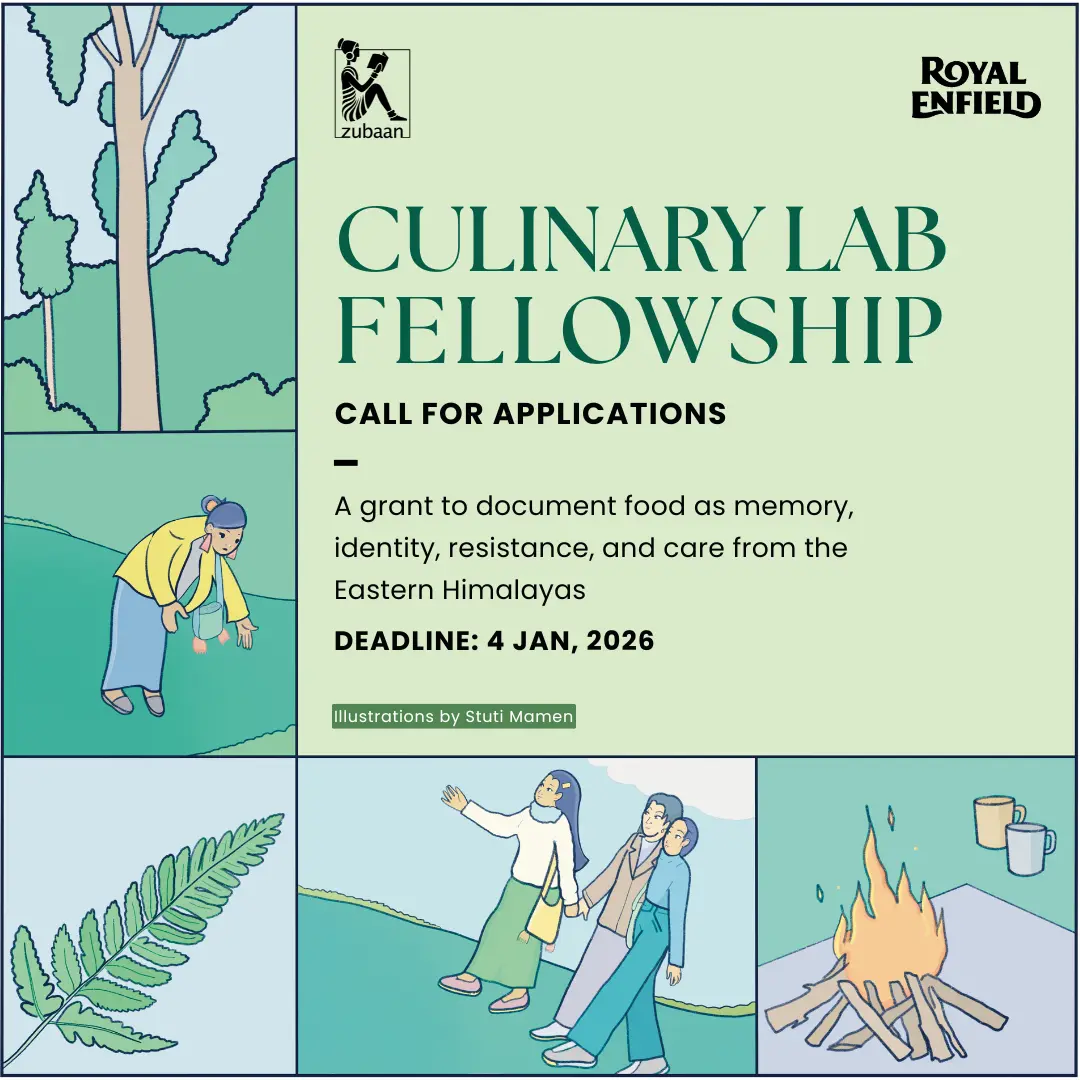
This year, Zubaan, in collaboration with Royal Enfield, is pleased to announce the first Culinary Lab Fellowship for young researchers and artists from the Eastern Himalayan region — specifically Darjeeling, Kurseong, Kalimpong, and the surrounding hills. The fellowship aims to support fresh, thoughtful work in written, visual, multimedia, and experimental formats.
We begin this initiative in the Eastern Himalayas, a region shaped by layered histories of migration, political struggle, and shifting borders. Here, communities have long negotiated belonging, labour, land relations, and ecological knowledge, giving rise to rich cultural practices. Food, especially, embodies these lived histories — holding stories of survival, adaptation, memory, and resistance. In the mountains, food becomes ritual, care, healing, recollection, seasonal knowledge, and movement across borders. Amid climate change, rapid urbanisation, and extractive development, food cultures endure as fragile yet powerful archives of intergenerational memory.
Drawing on Zubaan’s commitment to intersectional and grounded storytelling, the fellowship will select five fellows, who will be informed around 20 January 2026. They will participate in a three-day lab in early to mid-February, where they will explore food as a site where memory, ecology, culture, identity, land, and resistance intersect. The lab invites fellows to reflect on how meaning is created, preserved, and reimagined through everyday acts of cooking, growing, foraging, and sharing — and how these practices shape collective futures.
Theme
The fellowship approaches food as a living archive — carrying histories of migration, belonging, labour, ecological change, care work, and everyday resistance. We invite proposals that centre food through memory, storytelling, feminist practice, community knowledge, or cultural production.
We strongly encourage applications from women, queer persons, community researchers, home cooks, culinary practitioners, and others whose voices have been marginalized in mainstream documentation. Proposals may draw from oral histories, family archives, community recipes, traditional knowledge, changing food systems, rituals, indigenous practices, or personal narratives.
The primary output of the fellowship will be a collective book. Applicants may therefore frame their proposals around documenting recipes, gathering food stories, or conducting interviews. However, mixed-media approaches are equally welcome — including photography, essays, oral histories, archival material, recordings with transcripts, short videos, or hybrid formats.
Projects may take the shape of:
- An 8,000–10,000-word written submission
- A photo-essay (8–10 photographs with context)
- An audio/visual archive
- Or a hybrid, mixed-media project
Timeline & Mentorship
This fellowship will run for eight months. After the three-day lab, fellows will have four months to work on their first draft. Each fellow will be paired with an individual mentor who will support their research, documentation, and the development of their final output. Proposals should therefore be realistic, clearly planned, and achievable within this timeline.
Final submissions must be in English, though applicants may work in other languages as long as English translations or subtitles are provided.
While the primary focus of this fellowship is the creation of a book that brings together the fellows’ recipes, stories, and creative work, any additional materials that emerge from the research — such as video interviews, audio recordings, photographs, transcripts, or other mixed-media elements — may also be included in Zubaan’s larger digital archive, enriching the documentation of food cultures from the region.
[Note: Projects that are part of ongoing or recently completed PhD theses are not eligible.]
Duration
The first draft of the selected papers is expected in four months after the culinary lab. Depending on the online review and feedback meetings, papers may need to be revised after the first draft. After the feedback meetings, three more months will be provided for the final draft. The total duration of the grant is eight months.
Payments
The grant carries an amount of Rs 100,000, less applicable taxes.
Payments will be made in three instalments: 25 per cent on approval of the project and signature of the contract, 50 per cent on submission of the first draft and attendance of review meeting and the final instalment on completion of the study.
Deadline for submission: 11:59pm, January 4, 2026.
Who Should Apply?
- If you are from Darjeeling, Kurseong, Kalimpong and contiguous regions and between the age of 20-35 years, you are eligible to apply.
[Note: Preference will be given to candidates based locally and working actively within the community.]
- Demonstrated experience or strong interest in issues related to gender, food, culture, and sustainable development.
- Commitment to research and produce a substantial work equivalent to at least 10,000 words, which can take various forms such as:
- A long-form essay (minimum 10,000 words)
- A complete graphic story with at least five double-page spreads
- A photo essay featuring 8–10 images with detailed captions and contextual information
- A podcast series
- A culinary project combining recipes with stories
- A short film or other audiovisual work
The fellowship encourages creative outputs beyond traditional essays, including graphic narratives, extended interviews, audiovisual pieces, and more, all within an agreed timeline.
- Availability to participate in a 3-day residential workshop in Tezpur, Assam, scheduled for early to mid February, 2025.
How to apply
Please complete this Google Form (link here) and upload all required documents as specified.
List of documents required for upload:
- An updated CV and any other relevant information about yourself that you think is necessary, including proof of age.
- Send in a grant proposal (maximum two pages) which clearly describes what you wish to do, what sources you will tap (primary and secondary), the subject of your research and a timeline.
- Two names of referees, ideally people you have worked with.
- Please mention any special accommodations that you will require (example, disability accommodation, etc)
Note: The last date for submission of the application is 11:59 pm, Friday, 4th Jan, 2026
Selected candidates will be informed via email by 20th Jan, 2026.
Shortlisting and selection process
A selection committee will screen all applications. The committee will prepare a shortlist based on relevance to the Culinary Lab workshop’s priorities as described in this document and may wish to interview some candidates. Interviews can take place via Zoom or phone, or in person. The committee will then decide, and the candidate will be informed. The committee’s decision will be final.
Duration : 3 days of workshop, excluding travel days between early-mid February (this will be confirmed soon)
Payments : Accommodation and food will be provided during the workshop. Travel expenses will be borne by Zubaan.
__________
Registered in 2003, Zubaan is a charitable trust based in Delhi. It follows in the footsteps of its parent NGO, Kali for Women, and has been an active participant, chronicler and publisher of the women’s movement since 1984. It works to increase the body of knowledge on women with a special focus on South Asia and India. For more information, log onto https://zubaanprojects.org.
Royal Enfield, whose spiritual home lies in the Himalayas, has long been inspired by the region’s landscapes, cultures, and communities. Through the Eicher Group Foundation, it supports Himalayan communities and ecosystems, working towards protection, regeneration, and resilience in a rapidly changing world.
FAQs:
- What is the fellowship about?
The fellowship will explore the histories and cultures of food in the eastern Himalayan region, looking at how culinary practices shape identity, memory, and community. Through a feminist lens, the program will document and engage with the ways food traditions evolve — especially in the context of migration, displacement, and cultural preservation.
- Who can apply?
We invite young researchers, artists, storytellers, culinary enthusiasts, and community organisers working on food and culture in the eastern Himalayas to apply. We particularly encourage applications from young women, queer, trans, and non-binary people. Priority will be given to candidates rooted in the region and already working closely with local communities. This call is open only to Indian nationals.
- Can I apply if I live outside of India?
This is a physical, in-person workshop. You cannot apply if you are not a resident of India
- Is there an age limit to apply?
Yes, you must be between the age of 20-35 years to apply.
- What language should my submission be in?
All submissions should be in English.
- What kind of content can proposals be submitted for?
The proposal may aim for a collective recipe book as the primary output, and can focus on a research paper (8,000–10,000 words), a photo-essay, food-related stories, interviews, or other mixed-media formats.
- What should I not submit?
Masters or PhD thesis (whether completed or ongoing), proposals for fiction, poetry, etc., are not eligible as submissions.
- Does my submission need to be final, or can it be a draft?
You should submit a proposal which clearly describes what you wish to do during the grant duration.
- How do we submit multimedia proposals?
You can submit your multimedia proposals in the same format, with a link to a google drive housing the content.
- What will mentorship look like?
Mentors will be individually assigned to you during the grant period. You will be in touch with your mentors over email.
- Who will own the copyright to the work I submit?
All materials created with the support of the grant will be co-owned by the applicant and the granting organisations and will be governed by the Creative Commons Attribution-NonCommercial 4.0 International License.
Please note that your work will be published with Zubaan first, after which it may also be used for other purposes.
- Will my previously published/ screened work be eligible as a submission?
No